 Certified Transmission

In the world of transmissions, it's not enough anymore to think that we're only going to be testing and diagnosing the physical transmission, performing line pressure tests, or worrying about solenoids and apply charts. Often, we must take a whole vehicle approach and look at it from multiple angles to solve challenging problems. This was especially true in the case of a 2019 Ram 1500 5.7L four-wheel drive with an 8HP75 transmission that I recently had an opportunity to diagnose.
The customer's complaint was that the vehicle would randomly shift back into park during parking lot maneuvers, lock out the shifter while driving, and sometimes do one, the other, or both at the same time. There were also a host of random warnings on the dash, including shifter errors and parking sensor errors, along with the rear camera not working, the shifter knob not responding, and various other warnings that are too numerous to list. At times, it would throw on the emergency brake very quickly while backing up or trying to move forward. According to the customer, all these concerns were happening randomly and were very intermittent.
I have spent most of my 30-year career as a drivability technician in general repair. The last 12 years have been spent as a diagnostic technician for Certified Transmission. Over my career, I have realized, and continue to see, the benefit of a systematic approach to diagnostics: developing a process that you stick to every time, one that helps you slow down and gather information. That includes, but is not limited to, vehicle scans, appropriate wiring diagrams, code-setting strategies, and technical service bulletins. Printing that information out makes it possible to think strategically through all the symptoms you have and develop a plan of attack, so you don't waste time and effort pulling things apart and testing unnecessarily, or as in this case, chasing every symptom mentioned. Being armed with information before starting your battle helps you weed through the unnecessary and focus only on the probable. I always start my process with a system scan, then sit down with code definitions and code-setting criteria and search for technical service bulletins. At times, wiring diagrams can be massively helpful to me in understanding the system and identifying areas to start with.
In this case, I found U0159-00 codes stored in the instrument cluster, transmission control module, and ABS control module. (Figure 1)
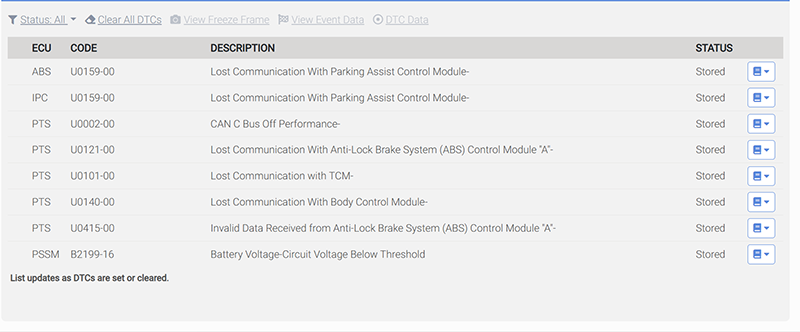
This code is a loss of communication with the parking assist module. In the parking assist module, I also found loss-of-communication codes for the transmission control module, instrument cluster, and ABS, along with a loss of communication with the shifter module.
The parking assist module having so many loss-of-communication codes with that many different modules, while the other modules only had a loss of communication with the parking assist module, was the very first clue that I was losing or dropping communication with that specific module.
During my TSB search, I found two that might be applicable. The first was bulletin 08-011-20, which directs a reflash of the driver assistance systems module to resolve various erroneous warnings, and addresses the unwanted e-brake application during gear shifts. The second was bulletin 08-240-25, directed specifically at the parking assist module. Although neither of these addressed all my concerns, both were reflash bulletins that could be easily performed so I added them to my list of things I might do. I spent about 30 minutes driving the vehicle under various conditions but was unable to reproduce the concern. After completing my diagnostic process, I spent some time becoming familiar with the system. I now felt I had a good understanding of the direction I wanted to head and of the system I was about to test.
Next, I connected the wiTECH to the vehicle so I could quickly monitor for communication dropouts with the module map, looking specifically for the parking assist module to lose communication, based on the information I had gathered so far. The module map on the wiTECH can be very useful because it shows codes and available flashes for all the modules on one screen. (Figure 2)
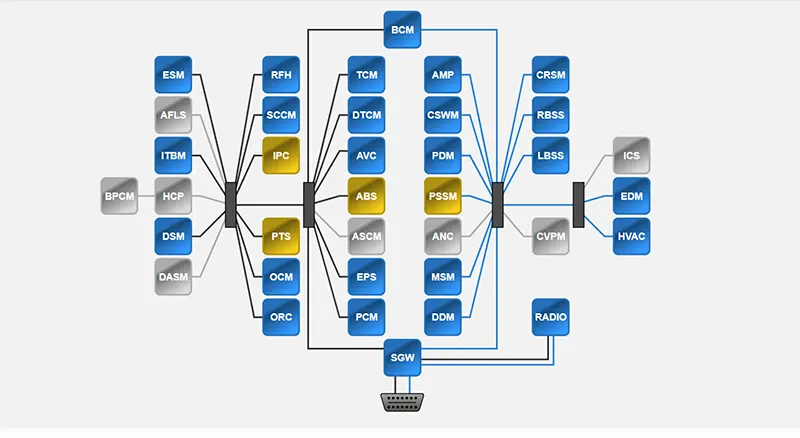
If a module drops communication, it immediately goes red on the map. Since this is a non-invasive way to check communication, it is where I decided to start. I moved, flexed, pushed, and manipulated the harness all the way through with no dropouts. Then I started shifting in and out of gear and doing a bunch of parking lot maneuvers, and lo and behold, the parking assist module (PTS on the module map) would momentarily drop out to red. (Figure 3)
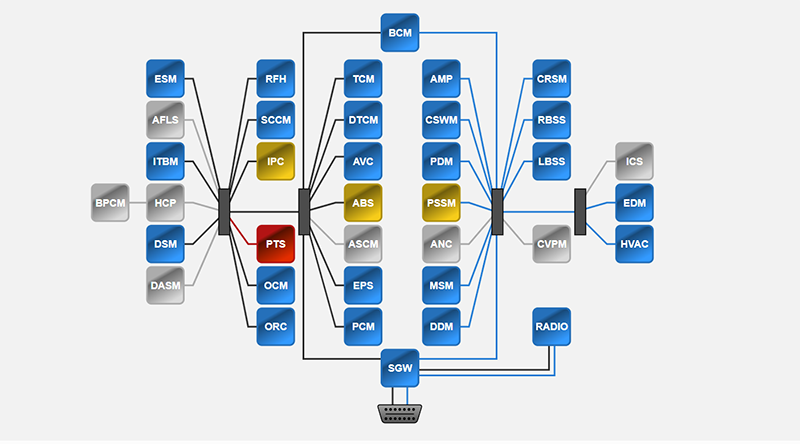
I saw this quickly happen two times, and a few, but not all, symptoms were also observed. I was only able to duplicate it twice over the space of 45 minutes or so. I was now starting to feel very comfortable that it wasn't a wiring concern, but most likely a module concern.
While I was tracing the communication circuit in the wiring diagram, I noticed that there was a star connector wired into the communication line. A star connector (or star CAN bus connector) in a Dodge, Chrysler, or Ram vehicle is a central junction block that ties together the various computer modules on the vehicle's network. There are several on this vehicle. I then made a list of what I thought it could be, which included the parking assist module and the star connector. Because the fault was so infrequent, I spoke with the customer and explained that it would need to occur more frequently to be tested for sure, or we might need to replace something as a test. The module itself was just a little over $100, and the star connector was close to $100. In my mind, those were the only two things it could be. So, with the customer's blessing, we started with replacing the PTS/parking assist module.
During programming, I noticed it dropped communication a few times when it shouldn't have, which was a little concerning, but it did go through, and I was able to complete the programming and perform a system reconfiguration. After checking it for most of the day and seeing no symptoms, I let the customer take the vehicle. Unfortunately, four days later, the vehicle came back, and the customer reported it was happening more frequently, but it was still very intermittent. This time, I connected the lab scope at the star connector to CAN C+ (violet wire) and CAN C- (yellow wire), the circuits coming from the C1 connector on the parking assist module. I spent every free moment I had over a day and a half flexing the star connector and the entire harness while monitoring the data lines. (Figures 4 & 5)
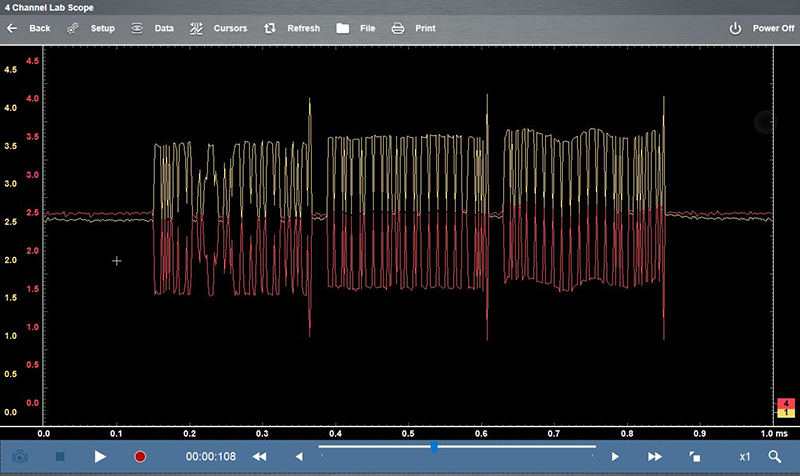
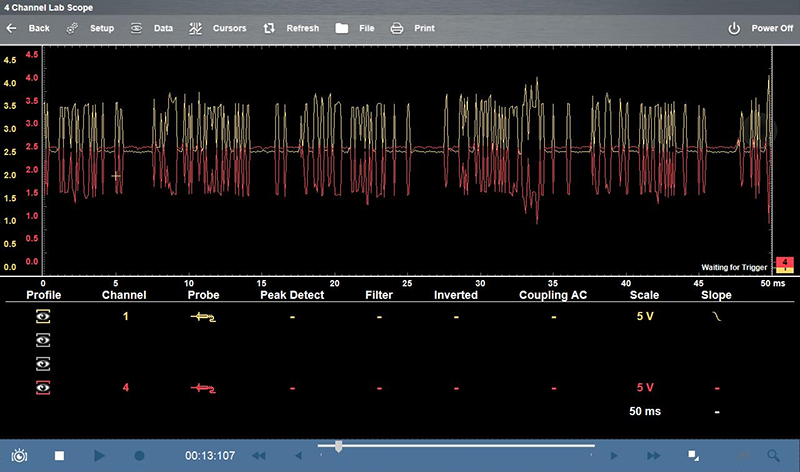
I also spent significant time performing parking lot maneuvers with the lab scope connected. This was done to double-check my first conclusion. I would love to tell you that I saw something and that was my reason for replacing the star connector, but I can't, because I never saw it drop out or exhibit any symptoms.
Still feeling confident in my first conclusion after rechecking and revisiting my thought process, and given that the PTS did not fix it, I continued with my original plan and replaced the star connector on the left side of the dash, right behind the panel that's accessible with the driver's door open. (Figures 6 & 7)
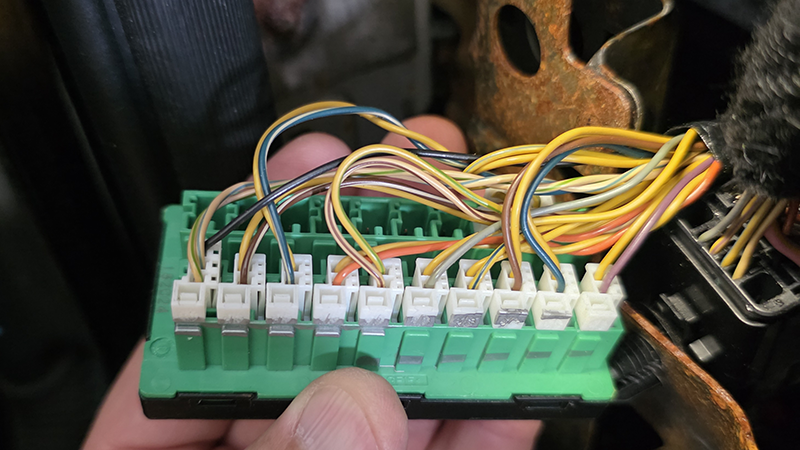
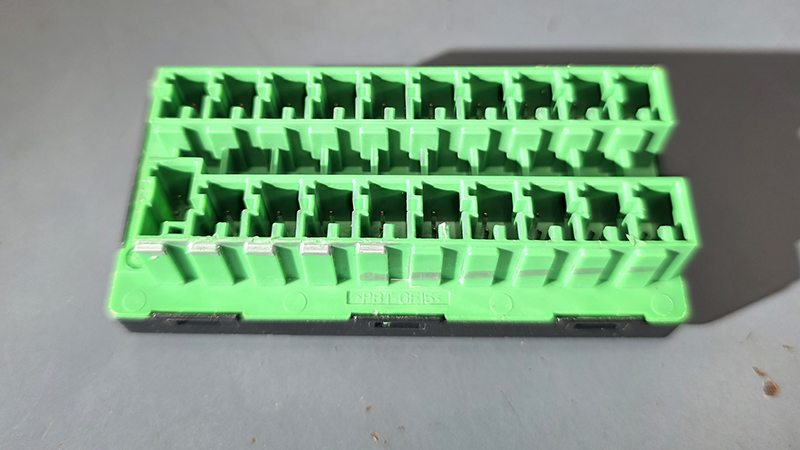
I spent some more time with the vehicle with no problem seen and gave it back to the customer for what I considered their part of the testing process. After a few weeks of it being gone, bingo, that was it. The customer was incredibly happy.
I truly do hate letting a vehicle go without knowing it's 100% fixed, but because of how intermittent the customer's concern was, I thought it was our best option, and it was what the customer wanted to do. They were very happy to have their vehicle fixed and thankful for the time we spent on it. Some well-placed testing, staying true to my process, taking time to familiarize myself with the system, and using deductive reasoning led us to resolve this customer's issue. Although I wish I could have captured the failure in action with a lab scope, taking the time to follow a strategic diagnostic process while remaining motivated to help our customer is what got this one fixed.