 Certified Transmission

A customer brought in a very clean 1994 Mustang GT convertible with a 5.0-liter engine and AODE transmission. With only 85,000 miles, the customer's complaint was an occasional slipping sensation. Another shop had already told him he needed a transmission.
We started our evaluation with a test drive, under-vehicle inspection, and computer scan. Our current scan tool wouldn't communicate with the car, so we dug out the old Snap-On "brick." It pulled no codes, but during the test drive I did notice the transmission acting up under hard acceleration on the 2-3 shift.
The fluid was dark red and burnt. At the customer's request, we conducted a pan inspection and found excessive clutch material and metal. Based on those findings, we sold him a remanufactured transmission. Since I was filling in as the diagnostician, I wasn't there when the replacement was installed.
A couple of weeks later, the customer returned with a different complaint. The transmission would reportedly lose third gear once it got hot. Again, there were no codes. Our warranty department pulled the transmission, inspected it, and found nothing wrong.
We reinstalled it, drove it about 25 miles, and it seemed fine. The location manager then asked me to test-drive it. After about 35 minutes, the problem returned. Once again, the scanner showed no codes, and I couldn't access any live data to see whether a shift solenoid was dropping out when the transmission got hot.
I started checking the basics. I found oily wiring at the output speed sensor and, after removing the conduit, discovered damaged insulation. Since fluid had reached the connector, we replaced the pigtail and sensor. Unfortunately, that wasn't the fix.
We now understood the symptom better. The transmission would shift 1-2, then, on the 2-3 command, drop back to first gear. It felt like the transmission was slipping or going into neutral. The problem only occurred when the transmission was extremely hot, and it wasn't consistent.
The MLPS checked good. The TPS was slightly out of specification at closed throttle, reading below one volt. Although it had already been replaced and wasn't adjustable, I loosened the mounting screws and set it to approximately one volt. After getting the transmission hot again, the voltage remained correct.
Still not the cause.
I began suspecting the PCM. I pulled it, load-tested the wiring to the transmission, and found everything good. I even used a heat gun on the PCM to see if heating it up would reproduce the problem. The car drove perfectly every time.
We eventually replaced the PCM, partly because we hoped it would also solve our inability to access live data. It did. With the replacement PCM installed, our Zeus scan tool finally gave us live data.
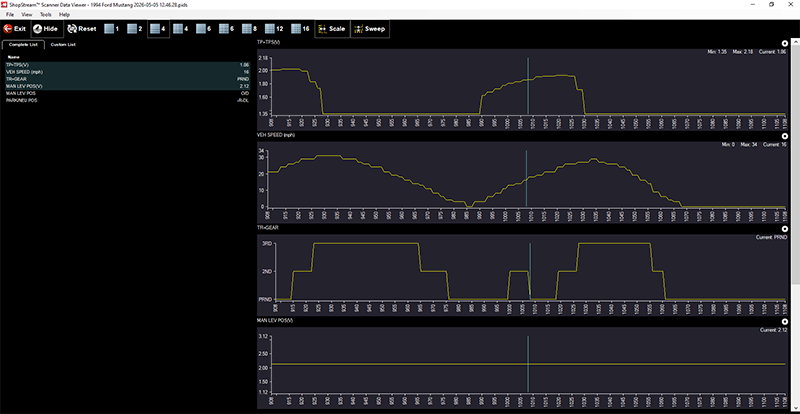
For a while, we thought we were making progress. During the 2-3 shift, the TR=GEAR PID would suddenly drop from 2nd to PRND, even though the MLPS voltage remained steady. That looked significant, but it still didn't explain what was actually happening. (Figure 1)
Scan report showing loss of communication with multiple modules.
I discussed it with our lead technician, Chris, and he was stumped too. We had data from the PCM, but we were still looking at the computer's interpretation of what was happening rather than the actual sensor signal. Chris reminded me that we still had an old Ford breakout box. I tracked it down at our Pacific location, buried in a back room. I hadn't used one in probably 20 years.
I connected the breakout box between the PCM and harness, then hooked up the scanner and oscilloscope. The TPS signal looked fine. I let the car run until it was thoroughly hot, then connected the scope to the output speed sensor circuit and went for a drive.
About 20 minutes later, the scope showed the OSS signal suddenly go open. We finally had our answer.
The OSS signal was dropping out at the exact time the transmission was losing the expected 2-3 shift and falling back to first. What felt like a transmission problem was actually an intermittent speed-sensor signal that only failed when the vehicle was hot and under driving conditions.
Unfortunately, the bad news was that we had caused the problem ourselves. The original sensor had been damaged during teardown, and the replacement we installed was not a genuine Ford part. Had I known that from the beginning, I might not have gone there first, but I certainly would have asked more questions sooner.
I apologize for not being able to save the scope data. The Zeus failed during the process and had to be sent out for repair.
This was a good reminder that intermittent sensor problems don't always show up during a static test. Sometimes the only way to find them is to reproduce the failure under the exact conditions in which it occurs. After chasing the valve body, transmission, wiring, MLPS, TPS, and even the PCM, the answer was finally sitting right there on the scope.
The moral of the story? No matter how long you've been doing this, sometimes you still end up going down the wrong rabbit hole. And when the usual tests aren't giving you the answer, you sometimes must stop looking at what the computer says is happening and look directly at the signal itself. Every day is an opportunity to learn. Details matter absolutely, and high-quality parts are essential.